
Join our community
One of the most frequently asked questions by men considering hormone therapy is: "Will TRT make me go bald?" It is a valid concern, as the link between testosterone and hair loss is widely known, but it is also heavily misunderstood.
Testosterone Replacement Therapy (TRT) itself does not inherently cause hair loss from scratch. Instead, it interacts with your existing genetics. Understanding the science behind hormone conversion, your individual genetic predisposition, and the preventative treatments available is essential for managing your hair while optimising your health.
Understanding the connection between your hormones, genetics, and hairline.
To understand why hair loss occurs, you have to look at a byproduct of testosterone called Dihydrotestosterone (DHT).
When you introduce testosterone into your body via TRT, an enzyme called 5-alpha-reductase converts a portion of that testosterone into DHT. DHT is a highly potent androgen responsible for many male characteristics, including facial hair growth and libido.
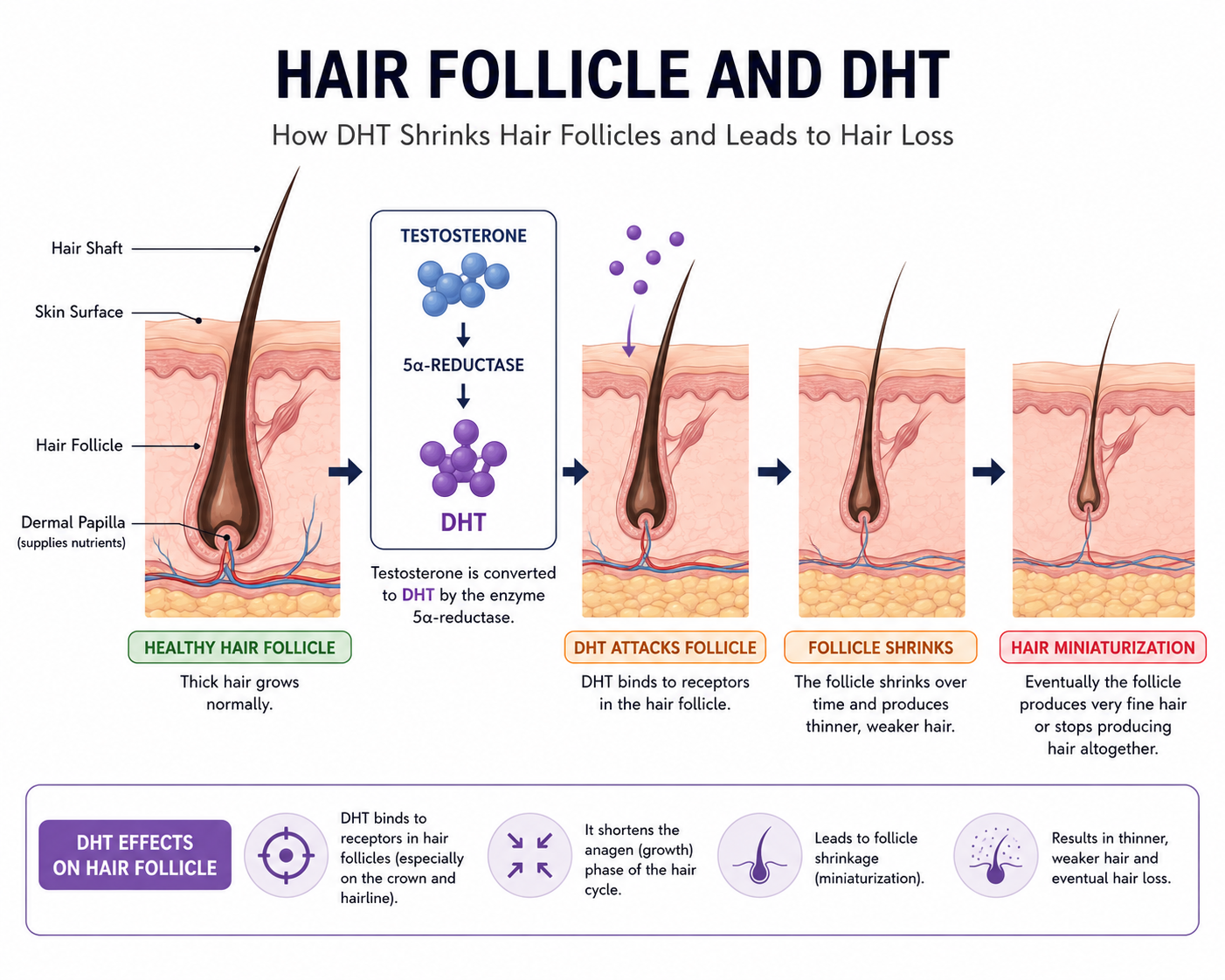
The impact of TRT on your hairline is almost entirely dictated by the genetic hand you were dealt. TRT acts as an accelerator, not the engine.
In our experience observing men on TRT, a clear pattern usually emerges: If you are already suffering from thinning hair or a receding hairline before starting treatment, TRT will likely speed up the process. The elevated DHT acts as a catalyst for the hair loss your body was already programmed to experience.
Conversely, if you have a thick, full head of hair and zero family history of male pattern baldness, starting TRT is highly unlikely to make your hair fall out. Your follicles simply lack the genetic sensitivity to DHT.
However, there are absolutely no guarantees. In healthcare, everyone is biochemically unique. We never make concrete promises about hair retention, as the human body can be unpredictable, and there is no single, set pattern that applies to 100% of patients.
If you are concerned about your hair but need TRT to restore your health and quality of life, you do not necessarily have to choose between the two. There are highly effective, clinically proven medications that can protect your hair follicles while on therapy.
Please note: These medications must always be prescribed and monitored by a registered clinician or pharmacist to ensure they are safe to use alongside your TRT protocol.
Finasteride is an oral or topical medication that blocks the 5-alpha-reductase enzyme, preventing a large portion of your testosterone from converting into DHT. By significantly lowering systemic or localized DHT levels, it removes the primary culprit attacking your sensitive hair follicles. It is widely considered the first-line defence for male pattern baldness.
Dutasteride works similarly to Finasteride but is significantly more potent. It blocks multiple pathways of DHT conversion, resulting in a much more profound reduction of DHT in the scalp and bloodstream. Because of its strength, it is typically reserved for aggressive hair loss where Finasteride has not been sufficient.
Available as a topical foam, liquid, or an oral tablet, Minoxidil does not block DHT. Instead, it acts as a powerful vasodilator. It dramatically increases blood flow and nutrient delivery directly to the hair follicles, stimulating the resting follicles to enter the growth phase. It is often used in combination with DHT blockers (like Finasteride) for maximum effect.
Disclaimer: The information provided on UKTRT is purely for educational purposes and does not constitute medical advice. We are not doctors. If you are experiencing hair loss or wish to start preventative medications like Finasteride or Dutasteride, you must consult your GP, a pharmacist, or a GMC-registered specialist to ensure it is safe and appropriate for your specific health profile.
The biological mechanisms of DHT and androgenetic alopecia discussed in this article are supported by clinical dermatology and endocrinology guidelines regarding the management of male pattern hair loss.
No. TRT only accelerates hair loss if you carry the genetics for male pattern baldness. If your hair follicles are not sensitive to DHT, increasing your testosterone levels should not cause your hair to fall out.
Hair loss is typically a gradual process. If you are genetically predisposed, you might start noticing increased shedding or thinning around the temples and crown within 3 to 6 months of starting TRT, as your DHT levels peak and remain elevated.
If caught early, miniaturised hair follicles can often be revived using treatments like Minoxidil and Finasteride. However, once a hair follicle is completely dead and the scalp is smooth, the hair cannot grow back through medication alone—a hair transplant would be required.
For most men, they are safe and highly effective when used alongside TRT. However, because they alter hormone pathways (by lowering DHT), they can sometimes cause side effects like reduced libido or mood changes. This is why they must be prescribed and monitored by a medical professional.
If you are already experiencing male pattern baldness or have a very strong family history of it, some clinicians recommend starting preventative treatments proactively—simultaneously or slightly before starting TRT—to protect the hair. Always discuss this strategy with your doctor.
While pharmaceutical treatments (like Finasteride) are the most effective, some men use adjuncts like Ketoconazole shampoo (Nizoral), which has mild local anti-androgen properties on the scalp. Microneedling (derma rolling) is also commonly used alongside topical Minoxidil to vastly improve absorption and stimulate the scalp.
This is a common myth. Baldness is dictated by how sensitive your hair follicles are to DHT, not simply by how high your overall testosterone is. Many men with naturally high testosterone keep a full head of hair for their entire lives.
Yes, it often does. Interestingly, while DHT can shrink follicles on the scalp, it actually has the exact opposite effect on facial and body hair. Many men on TRT report significantly thicker beards and increased chest or body hair.