Join our community
Testosterone levels typically peak during early adulthood and gradually decline with age. Research suggests that levels decrease by around 1–2% per year from the age of around 30.
While this gradual reduction is considered normal, some men experience a sharper decline or develop hormone deficiencies earlier in life. When this reduction is significant and confirmed through blood testing, it may be diagnosed as testosterone deficiency.
Low testosterone is relatively common, particularly in men over 40, although it can affect younger men as well. This guide breaks down the symptoms, diagnostic blood tests, and exactly how to access Testosterone Replacement Therapy (TRT) in the UK through both NHS and private clinic pathways.
The male body relies on testosterone to regulate everything from red blood cell production to sexual function, muscle mass, and emotional well-being. As you enter your 30s and 40s, a slight tapering of optimal hormone production is entirely expected.
However, a severe drop—often referred to clinically as male hypogonadism or Testosterone Deficiency (TD)—is not simply a byproduct of ageing. It is a recognized medical condition characterized by a biochemical deficiency in serum androgen levels combined with negative physical and psychological symptoms.
British Society for Sexual Medicine (BSSM) guidelines highlight that when an organic cause (such as a testicular issue or a pituitary gland disorder) or age-related comorbidities drive testosterone down to sub-optimal levels, treatment should be evaluated. Men should not have to live with a severely compromised quality of life just because their condition correlates with age.
Learn about UK blood test thresholds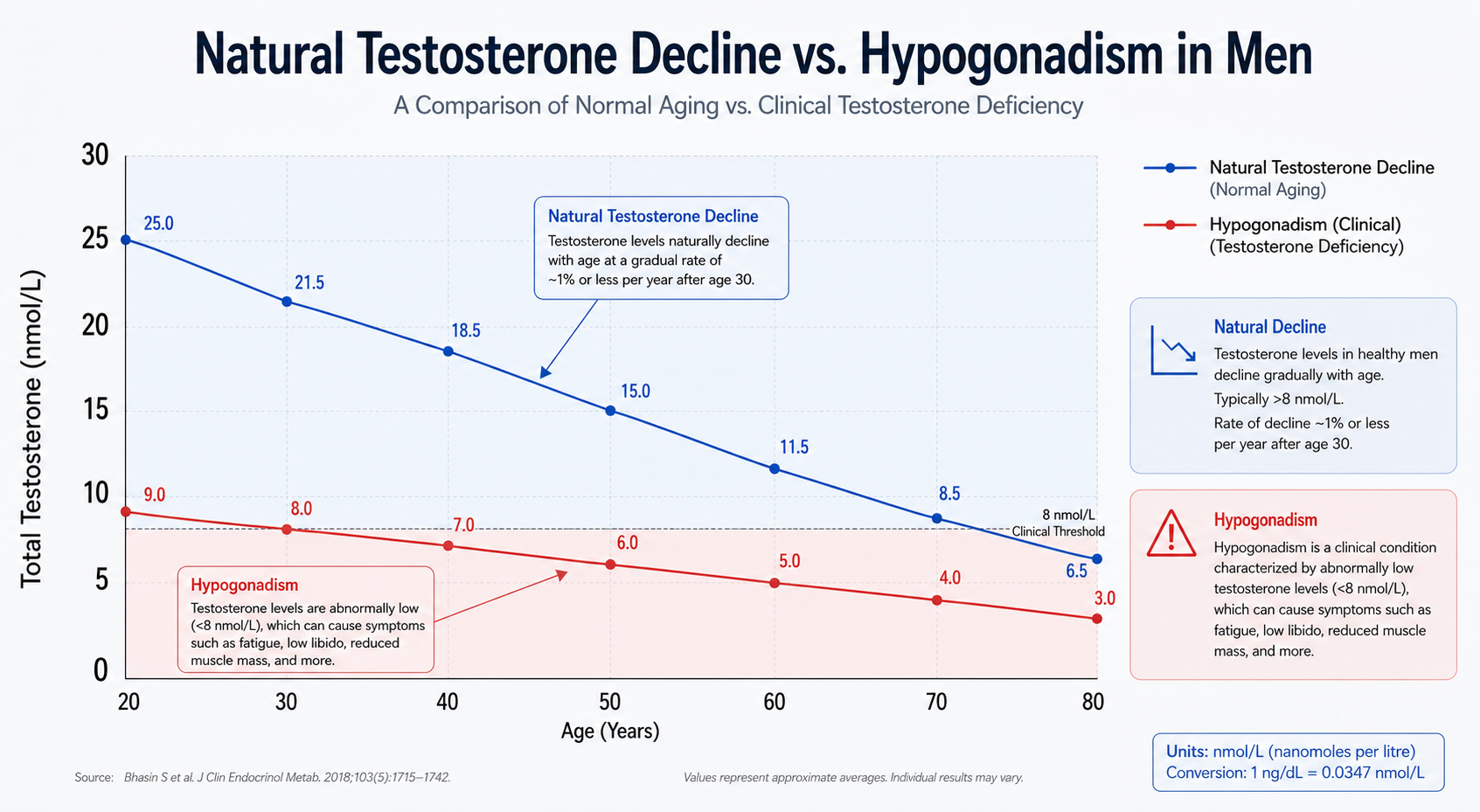
Because testosterone receptors are located throughout the entire body, a deficiency rarely presents with just one issue. Symptoms can be categorized into physical, psychological, and sexual changes. If you recognize several of these signs of low testosterone, it may be time to seek a clinical evaluation.
Symptoms alone are never enough to secure a prescription. UK medical protocols dictate that a clinical diagnosis must be supported by comprehensive TRT bloodwork taken in the morning (usually before 11 am) when natural production is at its peak.
Crucially, the criteria for treatment differs drastically depending on whether you rely on NHS endocrinology or follow modern guidelines in the private sector. A full diagnostic assessment evaluates these 15 key biomarkers:
The NHS Approach: Due to funding constraints and outdated guidelines, the NHS strictly limits access. Generally, your Total Testosterone must fall below 8 nmol/L (or slightly higher if you have other severe comorbidities) on two separate tests just to warrant an endocrinologist referral.
The Private Clinic Approach: Progressive private clinics look at the bigger picture, particularly the balance between Free Testosterone and SHBG. Many reputable private clinics will consider treatment for levels up to 15 nmol/L Total Testosterone and 0.225 nmol/L Free Testosterone. Furthermore, specialized TRT doctors can use their professional clinical discretion to prescribe treatment outside these strict boundaries if a patient is heavily symptomatic and their quality of life is severely impacted.

Once diagnosed, you must decide on a clinical pathway. Navigating NHS vs Private TRT is one of the most critical choices a patient makes.
The NHS pathway begins with your GP. While the medication is covered by the state, wait times can stretch into many months. If you do get approved, treatment options are largely limited to standard, messy testosterone gels or infrequent, large-dose injections (like Nebido) administered every 10-14 weeks, which often leads to dramatic hormonal peaks and valleys.
The Private pathway provides fast access and comprehensive hormone optimization. Private physicians focus on symptom resolution and stable blood levels, offering advanced treatment formats like micro-dosed subcutaneous injections (such as Cypionate or Enanthate) and customized scrotal creams.
Though private treatment requires an out-of-pocket investment (read our full breakdown on the cost of TRT in the UK), the proactive management of side effects, fertility preservation, and close, ongoing blood monitoring make it the preferred, safer choice for men who want real results.
Injections: Enanthate, Cypionate, Sustanon (Intramuscular or Sub-Q)
Topicals: NHS Gels or highly concentrated Private Creams
Ancillaries: hCG (to maintain fertility and testicular size) or Aromatase Inhibitors (if clinically required)
The NHS generally defines low testosterone as a Total Testosterone level consistently below 8 nmol/L. However, progressive private clinics assess the full symptomatic picture. Many private doctors will treat patients with Total Testosterone up to 15 nmol/L, or a Free Testosterone level below 0.225 nmol/L. Ultimately, doctors use their clinical discretion if a patient is heavily symptomatic even near the threshold of these ranges.
In the UK, private TRT typically ranges from £100 to £200 per month. This cost usually covers the medication, continuous clinical support, and necessary prescriptions. You will also need to factor in the cost of initial diagnostic blood work and routine monitoring tests throughout the year.
Yes, but options are highly restrictive. If you meet the strict criteria (Total T below 8 nmol/L), the NHS usually prescribes topical gels first. If injections are required, they heavily favor long-acting formulations like Nebido (Testosterone Undecanoate), administered every 10–14 weeks in a clinical setting, rather than the frequent, self-administered micro-dosing protocols preferred in private care.
Standard TRT suppresses your natural production of Luteinising Hormone (LH) and Follicle-Stimulating Hormone (FSH), which can lead to a significant drop in sperm production and testicular atrophy. However, many men preserve their fertility and testicular function while on TRT by integrating Human Chorionic Gonadotropin (hCG) alongside their testosterone protocol.
No. While both utilize testosterone, the goals are completely different. TRT is a legal, medical treatment aimed at safely restoring your hormone levels back to a healthy, natural physiological range under strict doctor supervision. Steroid abuse involves taking massive, non-physiological doses—often stacked with underground compounds—to achieve supra-physiological muscle growth at the expense of long-term health.